
Localism
GOVERNMENT PERFORMS U-TURN ON PLANS TO DELAY LOCAL AUTHORITY ELECTIONS
Government plans to delay elections in 30 council areas across England have been abandoned. The decision comes following legal concerns after Local Government Secretary Steve Reed had approved delays for the ballots until 2027. The Government said that was to help deliver a major reorganisation that will see some local authorities abolished.
Reform UK launched a legal challenge against the plans, which was due to be heard in the High Court in late February and party leader Nigel Farage said: “We took this Labour government to court and won. In collusion with the Tories, Keir Starmer tried to stop 4.6 million people voting on 7 May.” The Government will pay Reform’s legal costs and also provide an extra £63million to the councils concerned to enable the elections to go ahead.
In a letter to council leaders, Mr Reed said the Government had written to the High Court to confirm he had decided to withdraw the original decision.
The statement said: “The secretary of state invited the housing minister, who was not involved in the initial decision-making, to reconsider the position afresh on a very urgent basis recognising the pressing time-scales involved. The housing minister has decided that the elections should proceed in May 2026.”
A total of 343 parish and town councils across 15 county association areas will go ahead as planned, having expressed concerns about having to shoulder the full financial burden of running their own elections where principal authorities had delayed theirs. Elections to the new unitary councils are expected to take place in May 2027, with the new councils due to be up and running in April 2028.
Clerks & Councils Direct, March 2026
GUIDELINES TO SET UP A NEW COUNCIL
THE NATIONAL ASSOCIATION OF LOCAL COUNCILS has produced details of how to create a new parish or town council. It involves structured steps to ensure community support and proper governance. These include researching the legislative process and engaging with the community to gather support, as well as information about elections for council members. View it online here: https:// tinyurl.com/NALCnew
Clerks & Councils Direct, March 2026
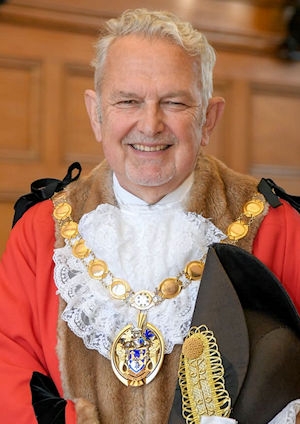 King’s Lynn and West Norfolk Mayor Andy Bullen will be one of the last to serve in the current administration. | TOWNS CONSIDER GOING IT ALONE Several towns across England are asking residents if they want new town councils, in the wake of the loss of borough and district councils. Apart from King’s Lynn, every other part of West Norfolk has its own parish/town council, including Hunstanton and Downham Market. These will remain under the Government’s reorganisation plans. However, the plans are for a split of services between the county council and seven districts with one, two or three big ‘unitary’ councils running all council services across larger areas. When the Borough Council of King’s Lynn & West Norfolk is replaced by the new unitary council or councils in April 2028, only unitary councillors covering large areas would be representing the town. Special arrangements will also be needed to maintain Lynn’s Mayor and proud civic traditions when the borough council is replaced. Residents in Market Harborough are being encouraged to take part in an initial phase of consultation looking at the future of local decision-making. The Leicestershire town does not have a parish council, meaning that the district council provides services, such as parks, play areas, cemeteries and bus shelters that in other parts of the district would be provided by a parish council. The costs of these services are charged to Market Harborough residents as special expenses. If a parish council existed, these services could be transferred to the parish, ensuring that local people, businesses and communities continue to have a say in how their area is run. It is a similar situation in Stafford, where letters have been sent to all households asking for feedback on the proposal. A report to Stafford Borough Council said a cross-party working group had recommended that the area to be reviewed should encompass the unparished area of the borough and the current parished area of Doxey. Borough councillors are worried there will be a lack of representation for the county town. One council is ahead of the game, with a new Tonbridge Town Council expected to be elected in May 2027. Tonbridge & Malling Borough Council has been investigating the idea since last year. After two consultations, the authority is expected to have given the creation of the new council the green light. A total of 72 per cent of respondents in its survey supported the creation of a new town council, 23 per cent were opposed. The proposal for a Tonbridge Town Council with six wards, reflecting those used for borough council elections, was due to be voted on at the end of February. Clerks & Councils Direct, March 2026 |
REVIEW OPENS DOOR FOR MORE COUNCILS
A KIRKLEES councillor has called for two villages to get their own parish council, as a review of the current local government system continues.
The West Yorkshire district has five parish and town councils – Denby Dale Parish Council, Holme Valley Parish Council, Kirkburton Parish Council, Meltham Town Council and Mirfield Town Council. Holme Valley North councillor Charles Greaves is calling for the creation of parish councils to serve Honley and Brockholes, and the Holmfirth area.
■ WORCESTER should have its own ‘city parish council’ when Worcestershire moves to a unitary system of local government. That is according to councillor Adam Scott, who said a new lower-tier council for the city should be formed, as has been done in other areas that created unitary authorities.
■ SPALDING could be getting its own parish council after councillors agreed to look into the proposal. South Holland District Council leader Nick Worth said the likely changes of local government reorganisation had prompted the plan for the Lincolnshire town. A working group of seven councillors will consider feedback from a consultation to present to the council.
■ A petition calling for the creation of a MARKET HARBOROUGH Town Council has been presented to the local authority after gathering more than 2,000 signatures. The petition was handed to Harborough District Council leader Phil Knowles. Supporters of the petition claim that a town council would ensure the Leicestershire town has strong local representation when a reorganisation of local government is completed.
Clerks & Councils Direct, January 2026
QUALITY GOLD FOR CANVEY ISLAND
CANVEY Island Town Council in Essex has received prestigious Quality Gold status as part of NALC’s Local Council Award Scheme (LCAS). This achievement recognises that the council achieves good practice in governance, community engagement and council improvement and goes above and beyond its legal obligations, leading its community and continuously seeking opportunities to improve and develop further. The Award Scheme report highlighted the council’s particular areas of strength, including meeting all requirements of the Foundation and Quality Standards and being at the forefront of best practice by achieving an excellent standard in community governance, community leadership and performance management. The LCAS is a peer-assessed programme designed to provide tools and encouragement to councils at the beginning of their journey, as well as promoting and recognising those at the cutting edge of the sector.
According to NALC, Canvey Island and other local councils are on the front line of the government’s localism agenda and are doing as much as they can to deliver services while being efficient and cost-effective. The award was presented at the council’s Community Awards evening on 20 September. The mayor, Cllr Barry Palmer, said: “It is a great achievement to be one of such a small group of town and parish councils in Essex to have been awarded this standard, and to have achieved this in such a short space of time is a fantastic accomplishment.” The council is now reviewing ways in which it can continue improving on its offer.
Clerks & Councils Direct November 2021
SEEKING FEEDBACK ON NEIGHBOURHOOD PLANS
SILEBY Parish Council has recently concluded work on its Neighbourhood Plan and on 21 November 2019 the referendum was successful, with 90 per cent of people who voted voting yes.
We are looking forward to seeing the impact of the Neighbourhood Plan in the coming years as planning applications in the parish are determined with reference to the policies it contains. Indeed, we were delighted that even before the referendum, the Neighbourhood Plan was referenced by an inspector in his decision notice when refusing an appeal against a 228-dwelling development, noting that the appeal site sat outside of the settlement limits as identified by the Plan and, as such, was contrary to the relevant Neighbourhood Plan Policy.
We are aware of the powers that Neighbourhood Plans have as prescribed in national planning legislation, and their position alongside Local Plans in the statutory development plan as “equal partners”. However, we are also concerned about the level of discretion that local planning authorities appear to have in the weight they attribute to Neighbourhood Plans.
We have heard of many excellent local planning authorities that fully embrace the concept of neighbourhood planning, promote it amongst parish councils and work alongside community groups in ensuring that local aspirations are translated into workable planning policies, and then reference the Neighbourhood Plan and apply full weight to it when determining planning applications.
We are also aware of local planning authorities that appear to disregard Neighbourhood Plans when determining planning applications. Through conversations with colleagues, we are aware of disparaging remarks that have been made by planning officers that undermine the importance of neighbourhood planning and diminish its role in the planning system.
We feel that this is unhelpful and that greater awareness of the significance of Neighbourhood Plans across local planning authorities and greater consistency in their application is necessary if such planning is to achieve the outcomes that government intended when introducing it through the Localism Act in 2011.
We know that there are good local planning authorities that understand the value of Neighbourhood Plans, but we consider it essential that all local planning authorities follow this course.
The purpose of writing is to ask other parish councils that have prepared Neighbourhood Plans to reply with their experience of their local planning authority – good or bad. We would like to understand better the levels of support being made available by local authorities to highlight levels of inconsistency across the country and to seek to raise standards to the best possible level.
Rosemary Richardson
Clerk to Sileby Parish Council, Leicestershire
Clerks & Councils Direct January 2020